jet-engines.mechanics.im
A hundred pounds of air, and two of fuel
NASA says that in a typical jet engine, 100 pounds of air a second is combined with only 2 pounds of fuel a second. Most of the hot exhaust, the same official page adds, has come from the surrounding air. A jet does not carry its oxygen with it, as a rocket must. It drinks the sky.
A desk of jet-engine stories
Pick a story. A turbojet that pulls air in at the front, a fan that walks around the core, and two official first-run dates that this desk will not turn into a race.
During the Second World War, NASA’s gas-turbine page says, “a new type of airplane engine was developed independently in Germany and in England.” It was called a gas turbine engine. “We sometimes call this engine a jet engine.” Unlike a rocket, “the turbine engine gets its oxygen from the surrounding air,” and “does not work in outer space because there is no surrounding air.” [source]
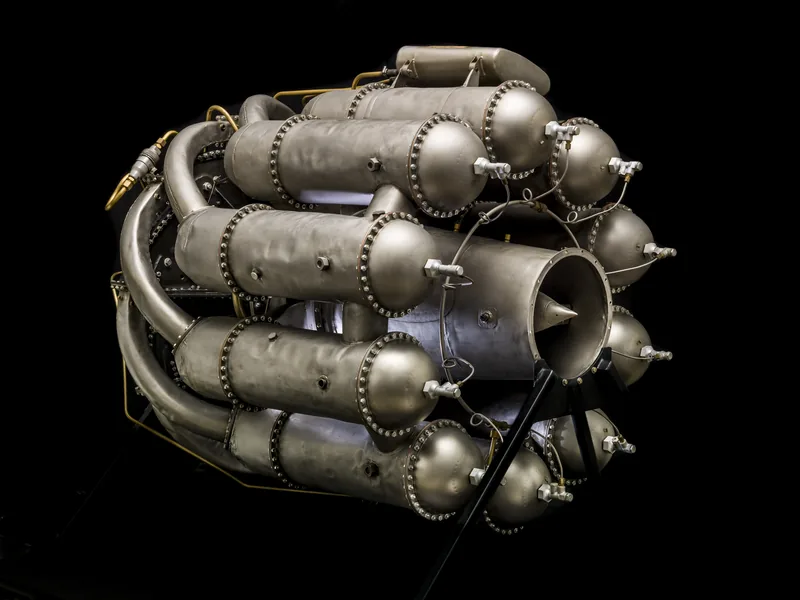
The National Air and Space Museum keeps the early official dates on two separate labels, and this site keeps them that way. Sir Frank Whittle’s engine was patented in 1932; Power Jets, Ltd. formed in 1936; “the Whittle Unit bench test engine first ran on April 12, 1937.” Dr Hans von Ohain’s HeS 1, a gaseous hydrogen-powered turbojet, “ran successfully in early 1937.” Early 1937, and 12 April 1937, are both official. This desk does not decide who ran first. [source] [source]
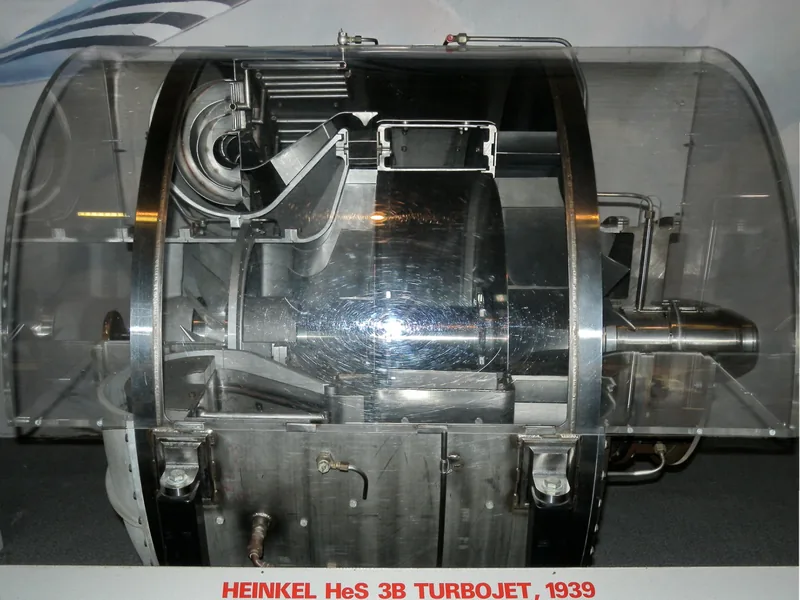
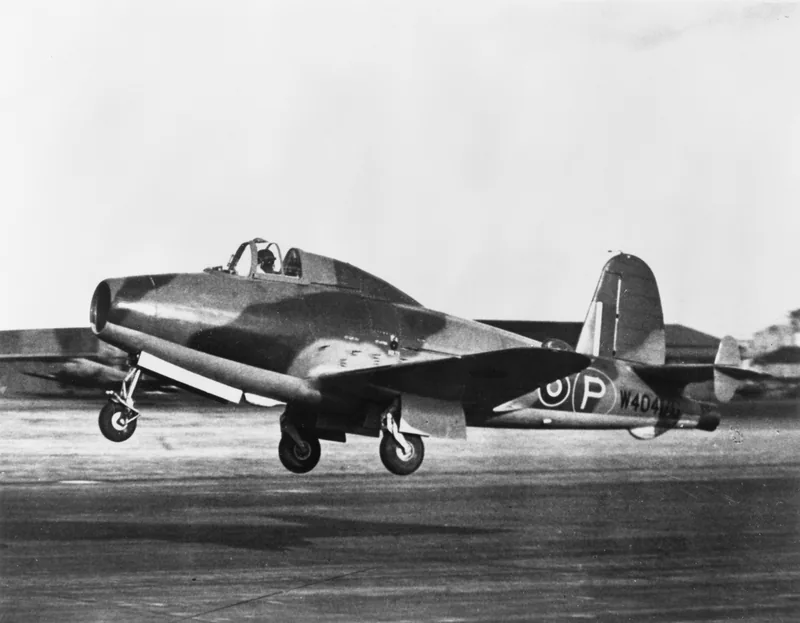
On 27 August 1939, the museum says, the HeS 3B powered the Heinkel He 178 on “the world’s first flight of a turbojet powered aircraft.” The W.1 flew officially in the Gloster E.28/39 on 15 May 1941, after the non-airworthy W.1X had already made short, straight hops during taxiing tests. The photograph at the top is that little British aircraft, W4041, circa 1941 — not captioned here as a picture of the official first flight itself. [source] [source]
Turbojet or turbofan, in official wording
NASA’s technical turbojet page and its turbofan page describe two families of gas turbine. The columns keep each page’s wording, and are not rewritten into the student “Engines” page.
| Turbojet (NASA, “Turbojet Engines”) | Turbofan (NASA, “Turbofan Thrust”) | |
|---|---|---|
| What it is | “The first and simplest type of gas turbine is the turbojet.” | “A turbofan engine is the most modern variation of the basic gas turbine engine.” “Most modern airliners use turbofan engines because of their high thrust and good fuel efficiency.” |
| Where the air goes | “Large amounts of surrounding air are continuously brought into the engine inlet.” On the student site, in a turbojet “all the air entering the intake passes through the gas generator.” That student sentence is not merged into this column. | Some incoming air “passes through the fan and continues on into the core compressor and then into the burner.” The rest “bypasses, or goes around the engine, just like the air through a propeller.” |
| Why it matters | “Because the exit velocity is greater than the free stream velocity, thrust is created.” | “Because the fuel flow rate for the core is changed only a small amount by the addition of the fan, a turbofan generates more thrust for nearly the same amount of fuel used by the core.” |
NASA’s student “Engines” page has its own figures — compression “3 to 12 times,” burner temperatures “about 1,100°F to 1,300° F,” and an afterburner increase “of about 40 percent in thrust at takeoff.” Those figures stay on that page, and are not written into the technical turbojet column. Notes about the exact wording live on the sources and field-notes pages.
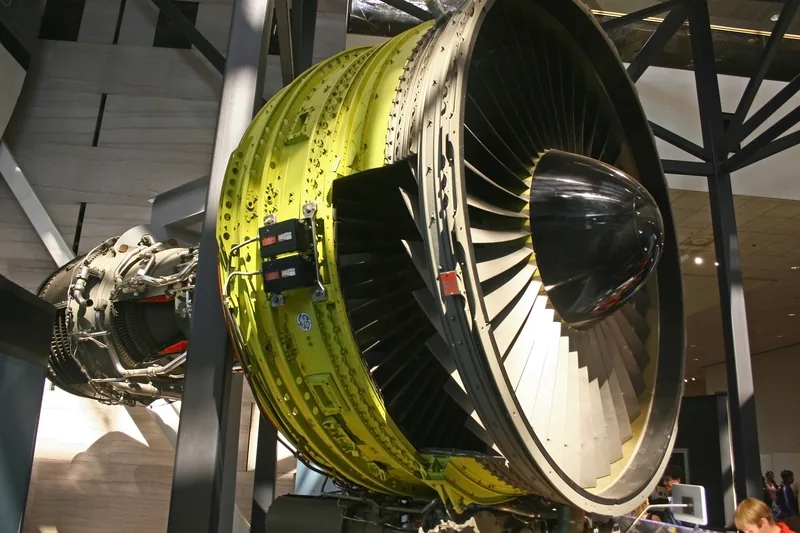
Most modern airliners, NASA says, use turbofan engines “because of their high thrust and good fuel efficiency.” A fan at the front sends some air through the core and the rest around it, “just like the air through a propeller.” The high-bypass engine in the photograph is a CF6, identified by the name on the file, and used here only on the website. [source]
Enjoyed this jet-engine desk?
No pop-ups. No intrusive advertising. Just interesting stuff. A little support helps the next mechanics.im site get built.