Questions
Questions people actually ask
- How does a turbojet work, in official wording?
- Air is brought into an inlet (or, as NASA notes, an intake), compressed, mixed with a little fuel and ignited; a turbine, “like a windmill,” turns the compressor; the leftover energy speeds the exhaust through a nozzle, and because the exit velocity is greater than the free stream velocity, thrust is created. [source]
- Why is so little fuel used, compared with the air?
- NASA’s typical figure is 100 pounds of air a second to 2 pounds of fuel a second. “Most of the hot exhaust has come from the surrounding air.” [source]
- What is a turbofan?
- NASA calls it the most modern variation of the basic gas turbine. A fan at the front sends some air through the core and the rest around it, “just like the air through a propeller,” producing more thrust for nearly the same core fuel flow. [source]
- Who flew first, officially?
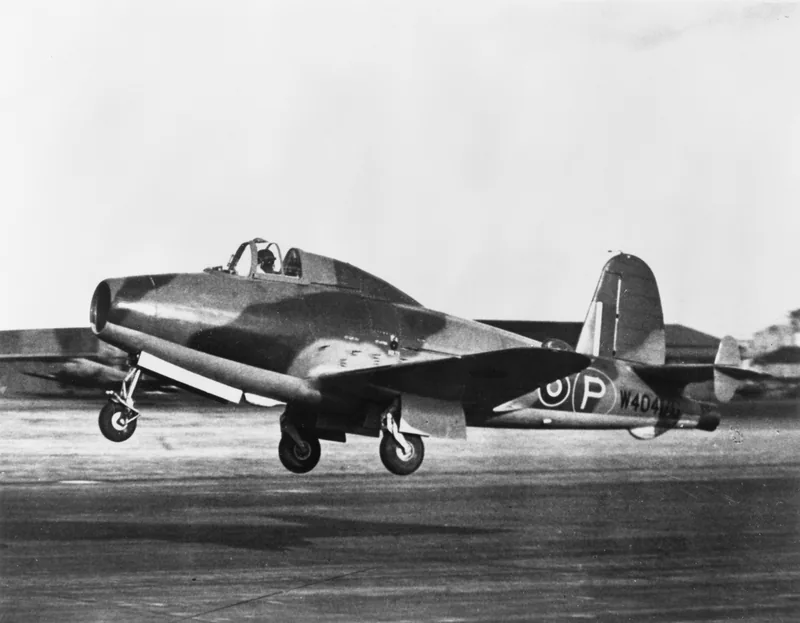
- The National Air and Space Museum says the HeS 3B powered the Heinkel He 178, on 27 August 1939, on “the world’s first flight of a turbojet powered aircraft.” The W.1 flew officially in the E.28/39 on 15 May 1941, after unofficial short hops by the W.1X. The first U.S. jet aircraft, on the same label, is the Bell XP-59A on 2 October 1942. [source] [source]
- Who ran first, on the bench?
- This site does not say. The Whittle Unit first ran on 12 April 1937. The HeS 1 “ran successfully in early 1937.” [source] [source]
- Is the museum’s HeS 3B the 1939 engine?
- No. It is a non-working reproduction, built from plans drawn by Dr von Ohain. [source]
- Why do two NASA pages sound slightly different?
- Because they are different official pages. The technical turbojet page and the student “Engines” page are not rewritten into one another. Student figures stay on the student page. [source] [source]
- Does a jet work in space?
- NASA says a turbine engine “does not work in outer space because there is no surrounding air.” A rocket must carry its oxygen. [source]
- Are the photographs the original flight engines?
- Not necessarily, and the captions say so. The W.1X is not the official flight W.1. The HeS 3 picture is a replica. The E.28/39 and XP-59A stills are not captioned as first-flight photographs.
- Does this site sell paid kits?
- No. There are three free typographic fact sheets, in A4 and Letter, plus the ReallyByte shop, Amazon searches and a birthday card.
Enjoyed this jet-engine desk?
No pop-ups. No intrusive advertising. Just interesting stuff. A little support helps the next mechanics.im site get built.