Two first runs, two first flights, and a crate for General Electric
The National Air and Space Museum tells the early jet story on two object labels. This site quotes both, and does not appoint a winner between a bench run in April and a bench run in “early” 1937.
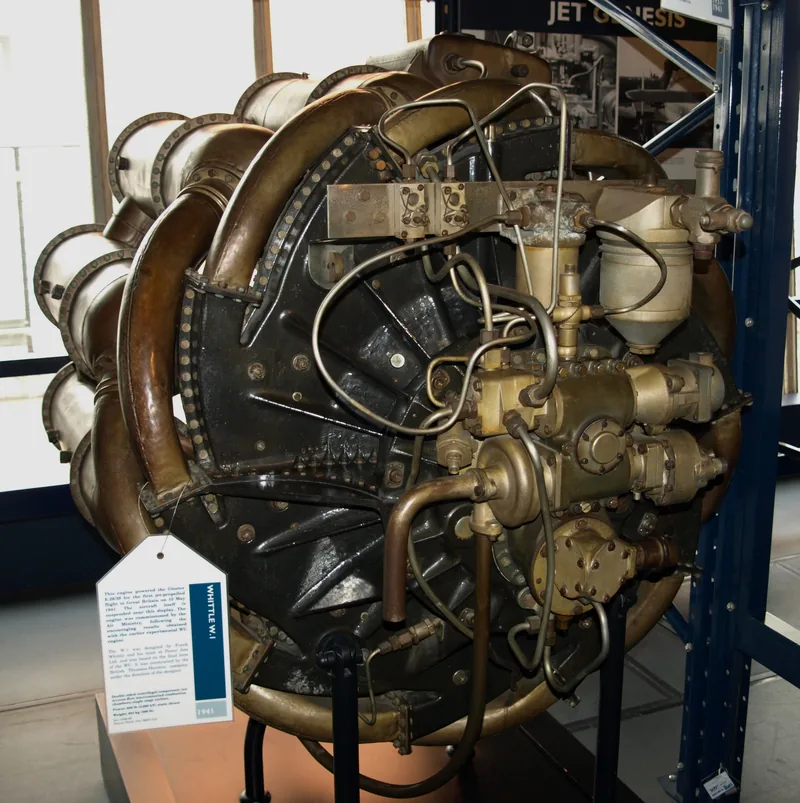
A Power Jets W.1 turbojet at the Science Museum, London, photographed by Nimbus227 on 22 September 2009. The file identifies it as a W.1. The National Air and Space Museum says the W.1 flew officially in the E.28/39 on 15 May 1941. This site does not treat the photograph as the particular engine from that flight, and does not repeat a further “first” claim from the file page. The file is in the public domain.Photo: Nimbus227, 22 September 2009, at the Science Museum, London · Public domain · Wikimedia Commons
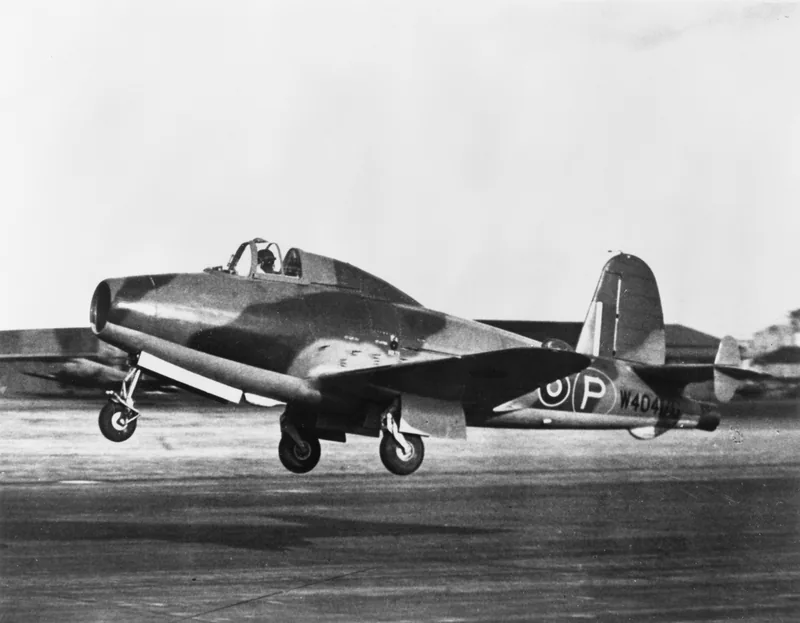
“Sir Frank Whittle’s jet aircraft engine was patented in 1932, and Power Jets, Ltd. formed in 1936. The Whittle Unit bench test engine first ran on April 12, 1937.” During taxiing tests, “the W.1X non-airworthy engine unofficially became the first British turbojet to be airborne when the E.28/39 made short, straight hops. The W.1 flew officially in the E.28/39 on May 15, 1941.” A shorter description on the same museum page says the engine “first flew on the E.28/39 in 1941 marking the unofficial first flight of a British jet aircraft.” That shorter “in 1941” is not combined here with 15 May 1941, and the W.1X is not captioned as the official flight engine. [source]
The Gloster E.28/39, serial W4041, at Farnborough, with Squadron Leader J. Moloney, circa 1941, photographed by Devon SA, a Royal Air Force official photographer. Imperial War Museums photograph CH14832A. The National Air and Space Museum says the W.1 flew officially in the E.28/39 on 15 May 1941. This picture is identified as W4041, circa 1941; it is not captioned here as a photograph of that first official flight. The file is in the public domain.Photo: Devon SA, Royal Air Force official photographer, Imperial War Museums CH14832A · Public domain · Wikimedia Commons
The museum’s physical description of the W.1X is kept to the object: type turbojet; thrust 5,516 N (1,240 lb) at 17,750 rpm, and 3,781 N (850 lb) at 16,500 rpm, “Derated for first flight”; compressor a single-stage, double-entry centrifugal; combustor ten reverse-flow chambers; turbine a single-stage axial; weight 254 kg (560 lb). Those figures belong to that label. [source]
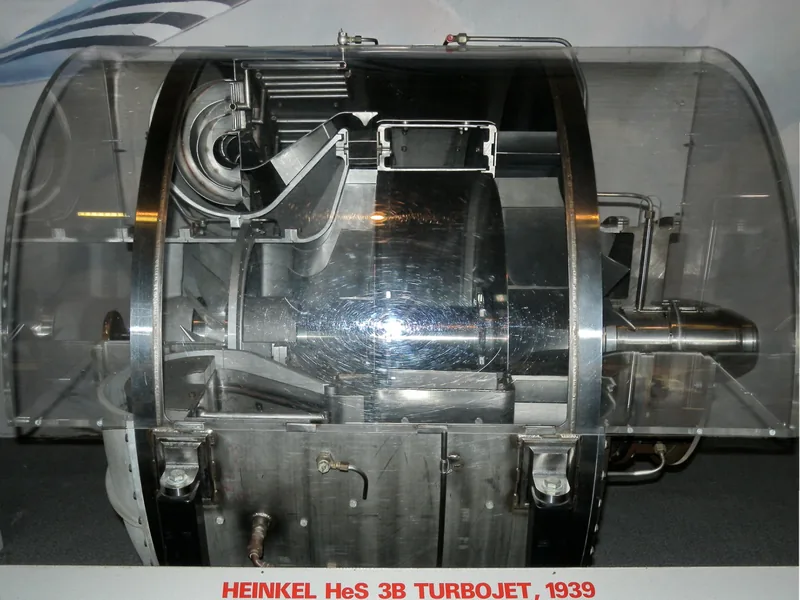
A replica of a Heinkel HeS 3 turbojet, photographed by Cliff on 7 March 2009. The National Air and Space Museum’s object of this type is a non-working reproduction, built from plans drawn by Dr von Ohain, and is not the 1939 flight engine. This photograph is of a replica, not that flight engine. The file is CC BY 2.0.Photo: Cliff, 7 March 2009 · CC BY 2.0 · Wikimedia Commons
On the other official desk, “Studies begun by Dr. Hans von Ohain in 1933…” led to a gaseous hydrogen-powered turbojet, the HeS 1, which “ran successfully in early 1937.” “The HeS 3B engine, which evolved in 1938, used internal fuel gasification initially rather than the desired atomized liquid fuel injection system used in later versions. On August 27, 1939, the HeS 3B powered the Heinkel He 178 on the world’s first flight of a turbojet powered aircraft.” [source]
The museum object is not that flight engine. “The German Engine Industry built this non-working reproduction under the leadership of the M.T.U. Co. at the request of the Deutsches Museum of Munich, Germany, from plans drawn by Dr. von Ohain.” Its label gives type as a single-shaft turbojet; thrust 4,412 N (992 lb) at 11,000 rpm; compressor a single-stage axial-flow inducer, centrifugal-flow; combustor a gaseous annular reverse-flow; turbine a single-stage radial; weight 360 kg (794 lb). [source]
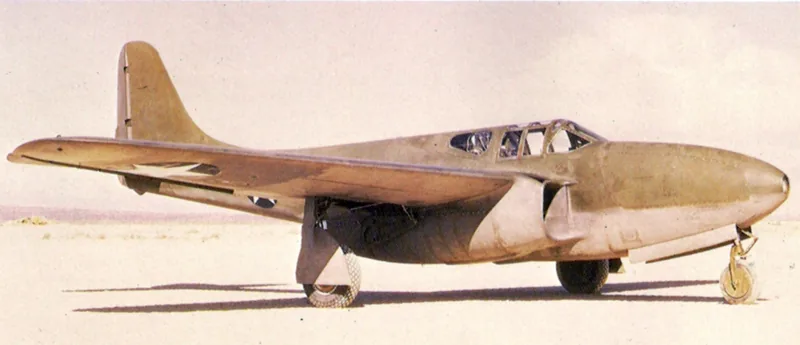
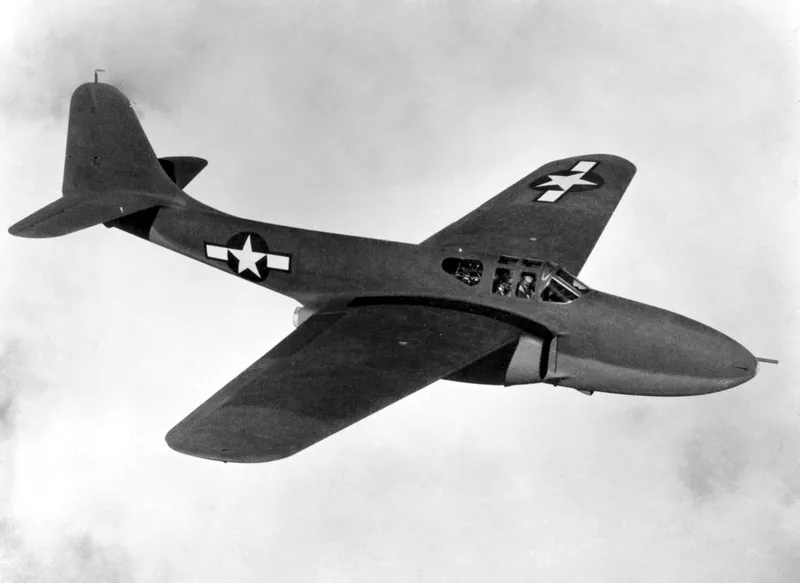
A U.S. Army Air Forces Bell XP-59A Airacomet, serial 42-108784, at Muroc Dry Lake, California, circa October 1942. The National Air and Space Museum says the Bell XP-59A Airacomet, powered by General Electric’s IA, was the first U.S. jet aircraft, on 2 October 1942. This caption identifies the airframe and place; it does not claim the photograph was taken during that first flight. The original is 1247 pixels wide, so there is no 1600-pixel image. U.S. government work in the public domain.Photo: U.S. Army Air Forces, circa October 1942 · Public domain (U.S. government work) · Wikimedia CommonsA Bell YP-59A in flight, a United States Air Force photograph. The file identifies the aircraft only as a YP-59A, a service-test Airacomet, not as the XP-59A that the National Air and Space Museum dates to 2 October 1942. U.S. government work in the public domain.Photo: United States Air Force · Public domain (U.S. government work) · Wikimedia Commons
Then the story crosses the Atlantic, still in the W.1X label. “The W.1X and drawings of the W.2B production engine were delivered to the General Electric Company on October 1, 1941. GE’s improved and uprated version, the IA, powered the first U.S. jet aircraft, the Bell XP-59A Airacomet on October 2, 1942.” The photograph of serial 42-108784 at Muroc is identified as an XP-59A, circa October 1942; it is not captioned as a picture of that first flight. The YP-59A in the air is a service-test Airacomet, not the XP-59A. [source]
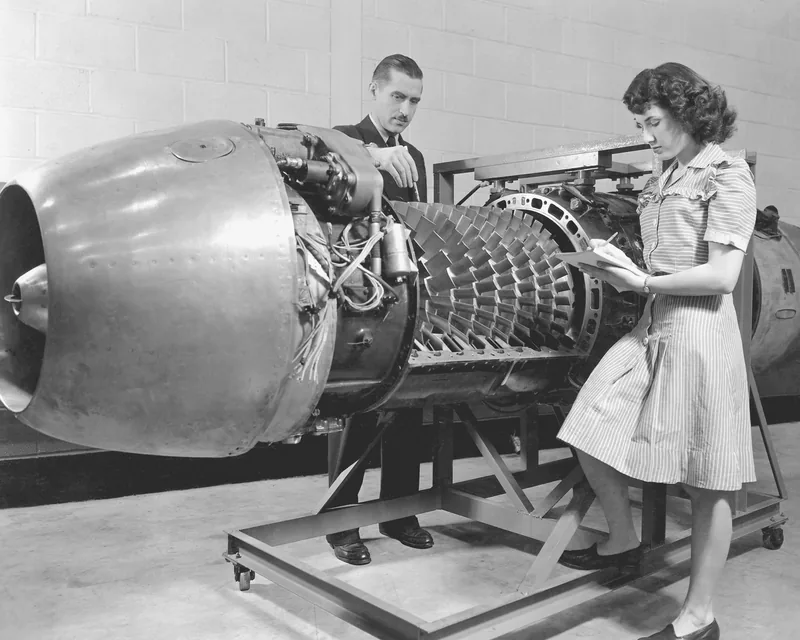
A Jumo 004 jet engine with its cover removed, being investigated at the Aircraft Engine Research Laboratory of the National Advisory Committee for Aeronautics, Cleveland, Ohio, on 24 March 1946. NASA photograph, U.S. government work in the public domain.Photo: NASA (National Advisory Committee for Aeronautics), 24 March 1946 · Public domain (U.S. government work) · Wikimedia CommonsKeep the lights on
Enjoyed this jet-engine desk?
No pop-ups. No intrusive advertising. Just interesting stuff. A little support helps the next mechanics.im site get built.