Facts
82 official facts, kept to their pages
Each fact below is taken from an official NASA sentence, a National Air and Space Museum object label, or a photograph’s own identification. Where two official pages use different wording, both are kept, and neither is tidied into the other.
A wartime engine, developed independently
NASA says that during the Second World War “a new type of airplane engine was developed independently in Germany and in England.” [source]
A gas turbine, sometimes called a jet
“This engine was called a gas turbine engine. We sometimes call this engine a jet engine.” [source]
Oxygen from the surrounding air
“Unlike the rocket engine which must carry its oxygen for combustion, the turbine engine gets its oxygen from the surrounding air.” [source]
It does not work in outer space
“A turbine engine does not work in outer space because there is no surrounding air.” [source]
The working fluid is the jet exhaust
“For a gas turbine engine, the accelerated gas, or working fluid, is the jet exhaust. Most of the mass of the jet exhaust comes from the surrounding atmosphere.” [source]
Thrust, and Newton’s third law
“Thrust is the force which moves any aircraft through the air.” “All thrust is generated through some application of Newton’s third law of motion.” [source]
Four official example aircraft
“The DC-8 is powered by four high-bypass turbofan engines, the F-14 by two afterburning low-bypass turbofans, the C-130 by four turboprop engines, and the T-38 by two turbojet engines.” [source]
The first and simplest type
“Most modern passenger and military aircraft are powered by gas turbine engines, which are also called jet engines. The first and simplest type of gas turbine is the turbojet.” [source]
Inlet, or intake
“Large amounts of surrounding air are continuously brought into the engine inlet. (In England, they call this part the intake, which is probably a more accurate description, since the compressor pulls air into the engine.)” [source]
A compressor like an electric fan
“The compressor acts like many rows of airfoils, with each row producing a small jump in pressure. A compressor is like an electric fan. We have to supply energy to turn the compressor.” [source]
Higher pressure than free stream
“At the exit of the compressor, the air is at a much higher pressure than free stream.” [source]
A small amount of fuel, ignited
“In the burner a small amount of fuel is combined with the air and ignited.” [source]
100 pounds of air, 2 pounds of fuel
“In a typical jet engine, 100 pounds of air/sec is combined with only 2 pounds of fuel/sec. Most of the hot exhaust has come from the surrounding air.” [source]
The turbine works like a windmill
“The turbine works like a windmill.” Energy extracted by it is used “to turn the compressor by linking the compressor and the turbine by the central shaft.” [source]
Enough energy left for the nozzle
“The turbine takes some energy out of the hot exhaust, but there is enough energy left over to provide thrust to the jet engine by increasing the velocity through the nozzle.” [source]
Exit velocity greater than free stream
“Because the exit velocity is greater than the free stream velocity, thrust is created.” [source]
Very little fuel is added to the stream
“For a jet engine, the exit mass flow is nearly equal to the free stream mass flow, since very little fuel is added to the stream.” [source]
Why modern airliners use turbofans
“Most modern airliners use turbofan engines because of their high thrust and good fuel efficiency.” [source]
The most modern variation
“A turbofan engine is the most modern variation of the basic gas turbine engine.” [source]
A fan in front, a turbine at the rear
“The core engine is surrounded by a fan in the front and an additional turbine at the rear.” [source]
A two-spool engine
“This type of arrangement is called a two spool engine; one ‘spool’ for the fan, one ‘spool’ for the core.” [source]
Some air into the core
Some incoming air “passes through the fan and continues on into the core compressor and then into the burner.” [source]
The rest bypasses, like a propeller
The rest “bypasses, or goes around the engine, just like the air through a propeller.” [source]
Bypass ratio
“The ratio of (m dot)f to (m dot)c is called the bypass ratio - bpr.” [source]
More thrust for nearly the same fuel
“Because the fuel flow rate for the core is changed only a small amount by the addition of the fan, a turbofan generates more thrust for nearly the same amount of fuel used by the core.” [source]
Low bypass, still more efficient than a turbojet
“Low bypass ratio turbofans are still more fuel efficient than basic turbojets.” [source]
Fighters and afterburning low-bypass fans
“Many modern fighter planes actually use low bypass ratio turbofans equipped with afterburners.” [source]
Student opening: a fan at the front
NASA’s student page, on “all jet engines”: “The engine sucks air in at the front with a fan.” That opening is not rewritten into the technical turbojet page. [source]
An electric spark lights the mixture
On the same student opening: fuel is sprayed and “an electric spark lights the mixture.” “The burning gases expand and blast out through the nozzle.” [source]
Air through the core and around it
The student opening also describes air going “through the core of the engine as well as around the core.” [source]
Three thousand degrees, unit not given
“By mixing this air with jet fuel, the temperature of the air can be as high as three thousand degrees.” The page does not say Fahrenheit or Celsius. [source]
Compressed 3 to 12 times
Turbojet section, student page: air “is compressed to 3 to 12 times its original pressure in compressor.” [source]
About 1,100°F to 1,300° F
Fuel is burned “to raise the temperature of the fluid mixture to about 1,100°F to 1,300° F.” The odd space before F is the page’s own typography. [source]
An afterburner after the turbine
An afterburner is “a second combustion chamber positioned after the turbine and before the nozzle.” [source]
About 40 percent more thrust at takeoff
“The result of this increase in temperature is an increase of about 40 percent in thrust at takeoff and a much larger percentage at high speeds once the plane is in the air.” [source]
In a turbojet, all the air through the gas generator
“In a turbojet all the air entering the intake passes through the gas generator, which is composed of the compressor, combustion chamber, and turbine.” [source]
Student turbofan wording
“A turbofan engine has a large fan at the front, which sucks in air. Most of the air flows around the outside of the engine, making it quieter and giving more thrust at low speeds. Most of today’s airliners are powered by turbofans.” [source]
Whittle patented in 1932
“Sir Frank Whittle’s jet aircraft engine was patented in 1932.” [source]
Power Jets, Ltd., 1936
“Power Jets, Ltd. formed in 1936.” [source]
The Whittle Unit, 12 April 1937
“The Whittle Unit bench test engine first ran on April 12, 1937.” [source]
Short, straight hops
During taxiing tests, “the W.1X non-airworthy engine unofficially became the first British turbojet to be airborne when the E.28/39 made short, straight hops.” [source]
The official flight, 15 May 1941
“The W.1 flew officially in the E.28/39 on May 15, 1941.” [source]
A shorter 1941 wording, kept apart
A shorter description on the same page says the engine “first flew on the E.28/39 in 1941 marking the unofficial first flight of a British jet aircraft.” [source]
W.1X thrust figures
Thrust: 5,516 N (1,240 lb) at 17,750 rpm, and 3,781 N (850 lb) at 16,500 rpm, “Derated for first flight.” [source]
W.1X compressor
Compressor: “Single-stage, double entry, centrifugal.” [source]
W.1X combustor and turbine
Combustor: “10 reverse flow chambers.” Turbine: “Single-stage axial.” Weight: 254 kg (560 lb). [source]
Delivered to General Electric, 1 October 1941
“The W.1X and drawings of the W.2B production engine were delivered to the General Electric Company on October 1, 1941.” [source]
The first U.S. jet aircraft, 2 October 1942
“GE’s improved and uprated version, the IA, powered the first U.S. jet aircraft, the Bell XP-59A Airacomet on October 2, 1942.” [source]
Von Ohain’s studies, 1933
“Studies begun by Dr. Hans von Ohain in 1933…” [source]
The HeS 1, early 1937
“Von Ohain’s gaseous hydrogen-powered turbojet engine designated HeS 1 ran successfully in early 1937.” [source]
The HeS 3B, 1938, and a first fuel system
“The HeS 3B engine, which evolved in 1938, used internal fuel gasification initially rather than the desired atomized liquid fuel injection system used in later versions.” [source]
27 August 1939, the He 178
“On August 27, 1939, the HeS 3B powered the Heinkel He 178 on the world’s first flight of a turbojet powered aircraft.” [source]
A non-working reproduction
“The German Engine Industry built this non-working reproduction under the leadership of the M.T.U. Co. at the request of the Deutsches Museum of Munich, Germany, from plans drawn by Dr. von Ohain.” [source]
HeS 3B reproduction thrust
Thrust: 4,412 N (992 lb) at 11,000 rpm. Type: “Turbojet, single-shaft.” [source]
HeS 3B reproduction machinery
Compressor: “Single-stage, axial-flow inducer, centrifugal-flow.” Combustor: “Gaseous annular reverse-flow.” Turbine: “Single-stage radial.” Weight: 360 kg (794 lb). [source]
NASA pages last updated 13 May 2021
The turbojet, turbofan and student Engines pages used here were last updated on 13 May 2021, on the official NASA Glenn sites. [source] [source] [source]
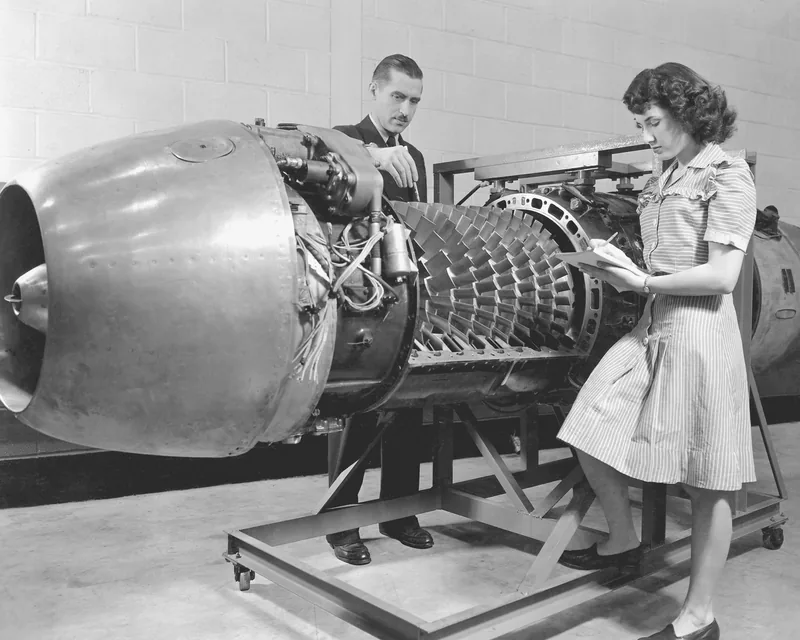
A Jumo 004 in Cleveland, 24 March 1946
The Jumo photograph is a NASA / NACA picture of a Jumo 004 with its cover removed, being investigated at Cleveland on 24 March 1946.
The W.1X photograph is not the official flight engine
The W.1X on this site is object A19500082000, photographed in 2016. The official 15 May 1941 flight engine, the museum says, was the W.1.
The HeS 3 photograph is a replica
The HeS 3 picture is a replica, not the 1939 flight engine.
The E.28/39 photograph is W4041, circa 1941
Imperial War Museums CH14832A, by Devon SA, shows Gloster E.28/39 serial W4041 at Farnborough, with Squadron Leader J. Moloney, circa 1941. It is not captioned as the official first-flight photograph.
XP-59A at Muroc, circa October 1942
USAAF photograph of serial 42-108784 at Muroc Dry Lake. The museum dates the type’s first flight to 2 October 1942. The caption does not claim this is that first-flight picture.
A YP-59A is not the XP-59A
The in-flight Airacomet photograph is identified only as a YP-59A.
A Power Jets W.1 at the Science Museum
Photographed by Nimbus227 on 22 September 2009. Identified as a W.1; not treated here as the particular official-flight engine.
A W2/700 at Farnborough, 22 January 2006
Identified only as a W2/700 on that date. Not treated as the W.1 of 15 May 1941.
A CF6, website only
Sanjay Acharya, 28 May 2008, CC BY-SA 3.0, used on the website only, not in the typographic sheets.
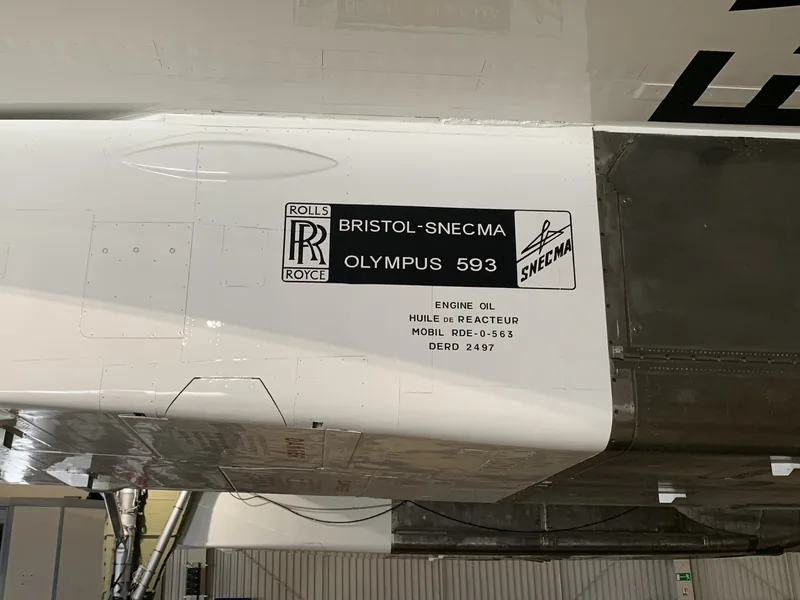
An Olympus 593, as the file identifies it
GerdeeX, 16 August 2022, CC0. Identified as the Rolls-Royce/Snecma Olympus 593 that equipped Concorde. No further official performance story is added.
A B-45A at Langley, 6 November 1949
NASA EL-2000-00269. Serial 47-021, said on the file to have been powered by four General Electric J35 turbojets.
An F9F-2 Panther at Langley, 16 April 1958
NASA EL-2002-00295. Bureau Number 122560, originally an F9F-3, later an F9F-2 with a Pratt & Whitney J42, used for handling-quality tests.
Technical and student figures are not merged
Compression “3 to 12 times,” “1,100°F to 1,300° F,” and “about 40 percent” stay on the student page, and are not written into the technical turbojet page. [source] [source]
Early 1937 is not compared with 12 April
The HeS 1’s “early 1937” and the Whittle Unit’s 12 April 1937 are both official, and are not used to decide who ran first. [source] [source]
A gas-turbine-parts link returned 404
A linked “gas-turbine-parts” page on the NASA site returned 404 on 17 November 2026 and is not cited. [source]
NASA wording is U.S. government work
The NASA sentences quoted here are U.S. government work. Diagrams on those pages are not reproduced on this site.
Museum labels are object labels
The Whittle and von Ohain figures are taken from National Air and Space Museum object pages A19500082000 and A19810039000. [source] [source]
This rebuild has no paid kits
The shop points to three free typographic sheets, printables.im, Amazon searches and the birthdays card.
GoatCounter is visible on every page
A “Visitors to this page” counter appears on every page of this site.
The desk does not invent a first runner
No page on this site converts the official 1937 dates into a claim about who ran a turbojet first.
The short museum wording is not upgraded
The shorter “in 1941” sentence is not rewritten into “15 May 1941.” [source]
Newton’s third law stays on the gas-turbine page
“All thrust is generated through some application of Newton’s third law of motion” is NASA’s gas-turbine wording, not added to the museum labels. [source]
Turbojet last updated 13 May 2021, Nancy Hall
NASA Official / editor on the technical turbojet and turbofan pages: Nancy Hall, last updated 13 May 2021. [source] [source]
Student page editor, 13 May 2021
Student “Engines” page: editor Dr Robert J. Shaw; NASA Official Tom Benson; last updated 13 May 2021. [source]
Ten reverse-flow chambers
The W.1X combustor, on the museum label, is “10 reverse flow chambers,” a figure kept to that object. [source]
Internal fuel gasification, at first
The HeS 3B, the museum says, used internal fuel gasification initially, rather than the later atomized liquid fuel injection. [source]
Enjoyed this jet-engine desk?
No pop-ups. No intrusive advertising. Just interesting stuff. A little support helps the next mechanics.im site get built.