Myths versus facts
What the sources do not decide
Early jet history is full of firsts. Official pages are more careful than the legends that grow around them. Here are twelve checks.
- Myth: This site can say who ran a turbojet first, Whittle or von Ohain.
- Fact: The museum dates the Whittle Unit to 12 April 1937 and the HeS 1 to “early 1937.” NASA says the wartime engine was “developed independently in Germany and in England.” This site does not appoint a winner. [source] [source] [source]
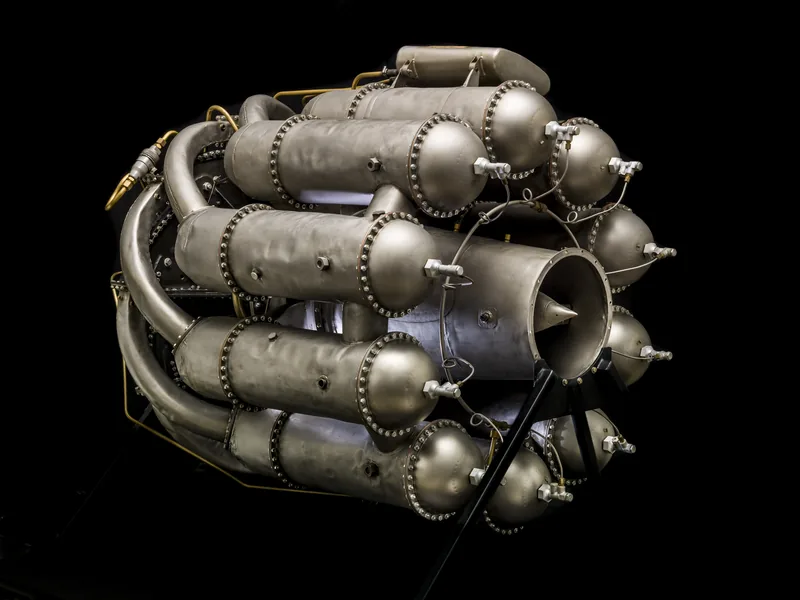
- Myth: The W.1X in the museum photograph is the engine that made the official British first flight.
- Fact: The longer label says the W.1 flew officially on 15 May 1941. The W.1X, a non-airworthy engine, made short, straight hops during taxiing tests. [source]
- Myth: The museum’s short “in 1941” sentence can be upgraded to 15 May 1941 and used as the same claim.
- Fact: The two wordings on the same page are kept apart. [source]
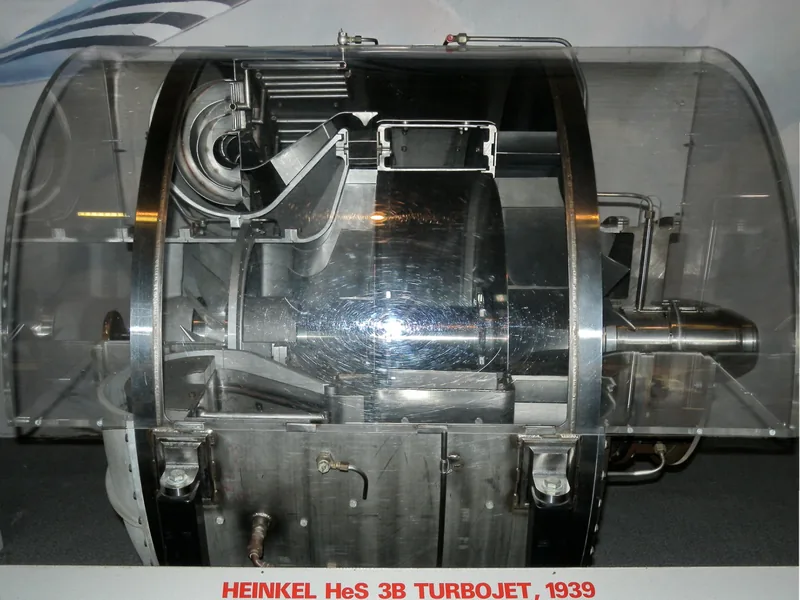
- Myth: The HeS 3 object in the museum, or the replica in the photograph, is the 1939 flight engine.
- Fact: The museum object is a non-working reproduction, built from plans drawn by Dr von Ohain. The photograph is of a replica. [source]
- Myth: NASA’s technical turbojet page and its student “Engines” page can be rewritten into one description.
- Fact: The student page has its own opening, and its own figures (3 to 12 times, 1,100°F to 1,300° F, about 40 percent). They stay on that page. [source] [source]
- Myth: “Three thousand degrees” on the student page may as well be called Fahrenheit, or Celsius.
- Fact: The page does not say. This site does not guess. [source]
- Myth: The E.28/39 photograph is a picture of the official first flight on 15 May 1941.
- Fact: It is identified as W4041 at Farnborough, circa 1941, with Squadron Leader J. Moloney. The official date is a museum sentence, not a caption for that still.
- Myth: The Muroc XP-59A photograph is the first-flight picture of 2 October 1942.
- Fact: The museum dates that first U.S. jet flight to 2 October 1942. The photograph is identified as serial 42-108784 at Muroc, circa October 1942, and is not captioned as that first flight.
- Myth: A YP-59A is the same aircraft as the XP-59A of 2 October 1942.
- Fact: The in-flight photograph is identified only as a YP-59A, a service-test Airacomet.
- Myth: A turbofan is just a turbojet with a bigger fire.
- Fact: NASA says a turbofan generates more thrust “for nearly the same amount of fuel used by the core,” because some air bypasses the core, “just like the air through a propeller.” [source]
- Myth: A jet engine, like a rocket, carries its own oxygen.
- Fact: NASA says the opposite. A turbine engine “gets its oxygen from the surrounding air” and “does not work in outer space.” [source]
- Myth: Unsourced “first turbojet” claims on a file page can be repeated in the caption.
- Fact: The W2/700 and W.1 photographs are identified as the files identify the objects. Extra “first” claims from file pages are not repeated as official history.
Enjoyed this jet-engine desk?
No pop-ups. No intrusive advertising. Just interesting stuff. A little support helps the next mechanics.im site get built.