The turbojet
Inlet, or intake? A compressor, a fire, a windmill
“The first and simplest type of gas turbine is the turbojet,” NASA writes. Most modern passenger and military aircraft are powered by gas turbine engines, “which are also called jet engines.” The path through a turbojet is a short official story, told here in that page’s own words.
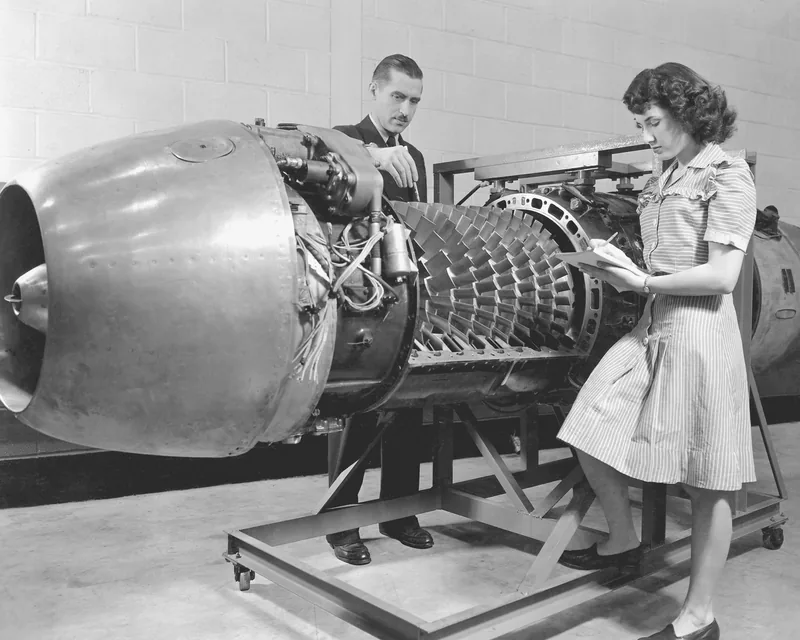
“Large amounts of surrounding air are continuously brought into the engine inlet. (In England, they call this part the intake, which is probably a more accurate description, since the compressor pulls air into the engine.)” At the rear of the inlet, the air enters the compressor. “The compressor acts like many rows of airfoils, with each row producing a small jump in pressure. A compressor is like an electric fan. We have to supply energy to turn the compressor. At the exit of the compressor, the air is at a much higher pressure than free stream.” [source]
“In the burner a small amount of fuel is combined with the air and ignited.” Then comes the figure that still startles: “In a typical jet engine, 100 pounds of air/sec is combined with only 2 pounds of fuel/sec. Most of the hot exhaust has come from the surrounding air.” [source]
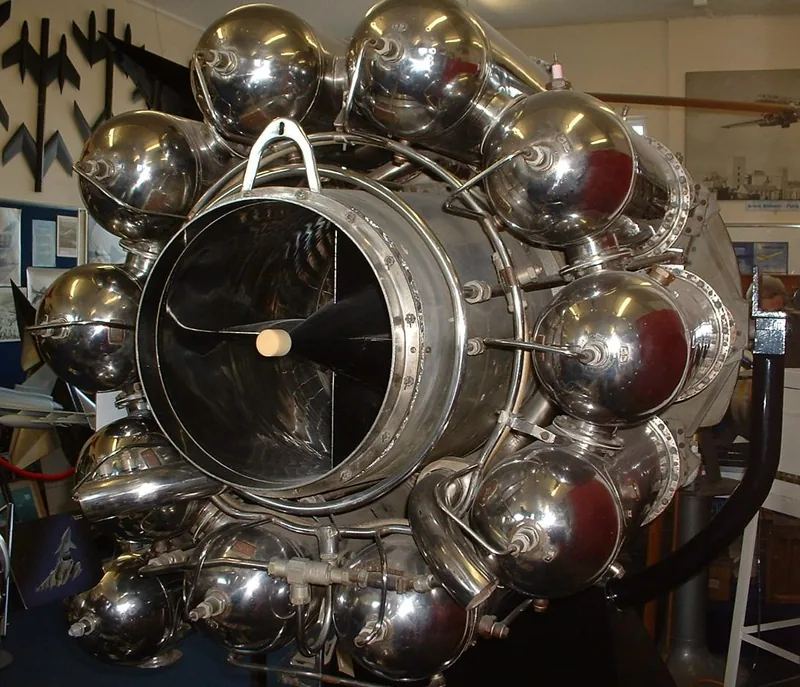
“The turbine works like a windmill.” Energy extracted by the turbine is used “to turn the compressor by linking the compressor and the turbine by the central shaft.” The turbine takes some energy out of the hot exhaust, “but there is enough energy left over to provide thrust to the jet engine by increasing the velocity through the nozzle. Because the exit velocity is greater than the free stream velocity, thrust is created.” “For a jet engine, the exit mass flow is nearly equal to the free stream mass flow, since very little fuel is added to the stream.” [source]
Thrust itself, on NASA’s gas-turbine page, is “the force which moves any aircraft through the air.” “All thrust is generated through some application of Newton’s third law of motion.” For a gas turbine, “the accelerated gas, or working fluid, is the jet exhaust. Most of the mass of the jet exhaust comes from the surrounding atmosphere.” [source]
NASA’s student “Engines” page tells a shorter, slightly different official story, and it is not rewritten into the technical one. “The engine sucks air in at the front with a fan.” “The blades spin at high speed and compress or squeeze the air.” Fuel is sprayed and “an electric spark lights the mixture.” “The burning gases expand and blast out through the nozzle.” That opening also describes air going “through the core of the engine as well as around the core,” which is the language of a fan engine, and is left on that page. [source]
The same student page then gives figures that the technical turbojet page does not: air “compressed to 3 to 12 times its original pressure,” and fuel burned “to raise the temperature of the fluid mixture to about 1,100°F to 1,300° F.” An afterburner is “a second combustion chamber positioned after the turbine and before the nozzle,” and “the result of this increase in temperature is an increase of about 40 percent in thrust at takeoff and a much larger percentage at high speeds once the plane is in the air.” “In a turbojet all the air entering the intake passes through the gas generator, which is composed of the compressor, combustion chamber, and turbine.” Those sentences stay attributed to the student page. [source]
Enjoyed this jet-engine desk?
No pop-ups. No intrusive advertising. Just interesting stuff. A little support helps the next mechanics.im site get built.